Looking for today’s Wordle answer?
This isn’t a spoiler page. If you want the daily solution, head to the official NYT Games site. What you’ll find here instead is something more useful long-term: a clear, practical guide to understanding Wordle clues so you can solve the Wordle puzzle consistently on your own.
If you play regularly, you know the moment. You open Wordle You type in a strong starting word. You hit enter. And then you stare at the grid thinking, Okay… now what?
Those green, yellow, and gray tiles are simple on the surface. But reading them correctly — that’s where most players either level up or quietly break their streak.
Originally created by Josh Wardle and later acquired by The New York Times, Wordle became one of the most successful digital word games ever. Today it lives inside NYT Games alongside titles like NYT Strands and NYT Connections.
But while many players search for Wordle hints or yesterday’s Wordle answer, fewer take the time to truly understand how the clues function. That’s the difference between guessing and solving.
Let’s break it down properly.
What Wordle Clues Actually Mean
Every guess in the Wordle puzzle produces three possible signals:
- 🟩 Green – Correct letter, correct position
- 🟨 Yellow – Correct letter, wrong position
- ⬜ Gray – Letter not in the word (with one important exception)
The rules are consistent. Wordle chooses one five-letter solution per day from a curated list maintained by The New York Times. The feedback system is deterministic — it follows fixed logic, not randomness.
The mistake most players make isn’t misunderstanding the colors. It’s misinterpreting what they imply about letter count and placement.
The Double Letter Rule (The Most Common Source of Confusion)
Here’s where things get tricky.
Imagine you guess:
SHEEP
Now suppose the solution contains only one “E.”
Wordle will:
- Mark one E as 🟩 or 🟨
- Mark the second E as ⬜
That gray tile does not mean the letter E isn’t in the word. It means you guessed it too many times.
This “double letter” mechanic trips up even experienced players. It’s the reason someone confidently eliminates a letter — only to discover later they misunderstood the clue.
If you want to improve your average solve rate, mastering this rule alone makes a noticeable difference.
Why Interpreting Clues Matters More Than Your Starting Word
People love debating the best starting word for Wordle. Some prefer vowel-heavy openers. Others like balanced consonant-vowel mixes.
A good opening guess helps, yes. But your ability to interpret Wordle clues is far more important.
Here’s a simple example.
Example Round
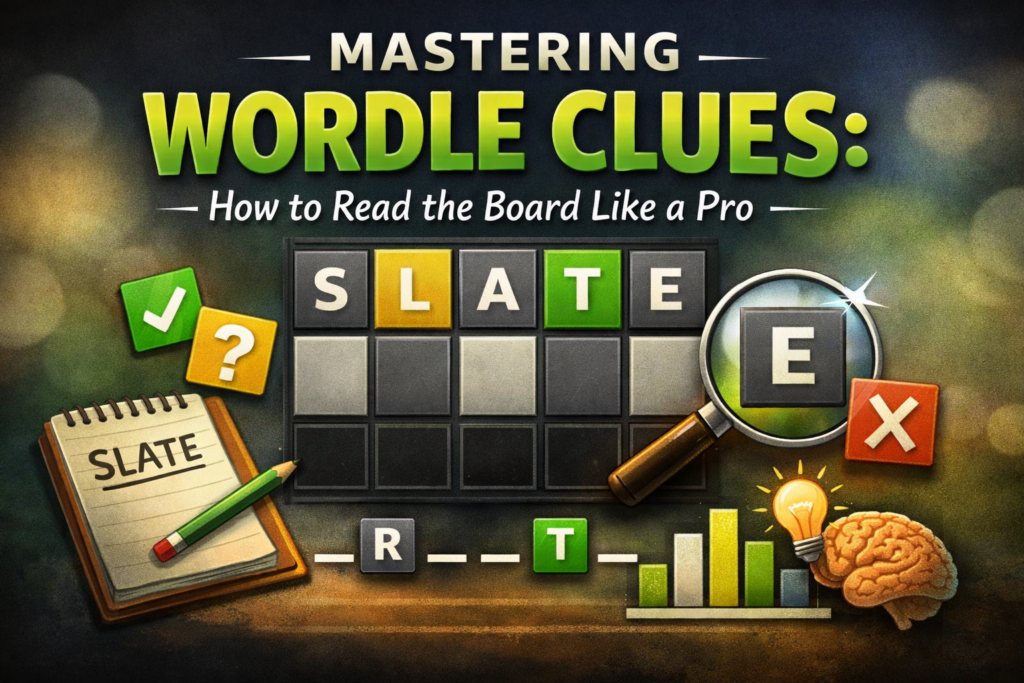
Guess: SLATE
Result:
- S ⬜
- L 🟨
- A ⬜
- T 🟩
- E ⬜
What does this actually tell you?
- T is locked into position four.
- L is in the word, just not in position two.
- S, A, and E are eliminated (unless a duplicate rule applies later).
Instead of guessing randomly again, you now construct your next guess around:
_ _ _ T _
And you reposition L intelligently.
That’s the shift: stop thinking “What word feels right?” and start thinking “What does the data allow?”
The Role of Letter Frequency
English letters don’t appear evenly. Linguistic frequency studies consistently show that some letters are far more common than others.
| Rank | Letter | Approx Frequency |
|---|---|---|
| 1 | E | ~12% |
| 2 | T | ~9% |
| 3 | A | ~8% |
| 4 | O | ~7% |
| 5 | I | ~7% |
This is why many experienced players choose opening guesses that test common vowels and consonants early.
It’s not about memorizing rare vocabulary. Wordle rewards probability-based thinking more than anything else.
How Hard Mode Changes the Game
Inside the settings of NYT Games, you can enable Hard Mode.
Hard Mode requires that:
- You reuse green letters in the same positions.
- You include yellow letters in subsequent guesses.
This removes the ability to “burn” a guess just to test new letters. Every move must respect previous Wordle clues.
Some players find it restrictive. Others say it sharpens their thinking dramatically. If you’ve been playing casually and want a new challenge, Hard Mode forces discipline — in a good way.
Wordle Compared to Other NYT Word Games
The New York Times has expanded its puzzle collection significantly.
| Game | Core Skill | Style of Clues |
|---|---|---|
| Wordle | Deductive reasoning | Positional color feedback |
| NYT Strands | Thematic discovery | Pattern-based |
| NYT Connections | Category grouping | Conceptual relationships |
NYT Connections hints revolve around finding shared categories. Strands requires spotting hidden theme words. Wordle, by contrast, strips everything down to pure letter logic.
That minimalism is part of its brilliance.
Common Mistakes When Reading Wordle Clues
Even seasoned players fall into predictable traps:
- Reusing letters already confirmed gray
- Forgetting the duplicate letter rule
- Guessing obscure words too early
- Ignoring positional logic
- Playing too fast after a lucky green tile
The biggest improvement often comes from simply slowing down. After each guess, pause. Reconstruct the board mentally. Double-check what’s truly eliminated.
It sounds basic, but it works.
Should You Use Wordle Hints?
There’s nothing inherently wrong with using Wordle hints — especially if you’re stuck on guess five and protecting a long streak.
That said, jumping straight to today’s Wordle answer removes the logical satisfaction that makes the game addictive in the first place.
If you need help:
- Look for progressive hints (category clues, vowel count, starting letter).
- Avoid pages that immediately reveal the solution.
- Stick to reputable sources or the official NYT Games platform.
Balance challenge with enjoyment. That’s the sweet spot.
The Psychology Behind the Colored Tiles
There’s a reason Wordle became a cultural phenomenon so quickly.
Each green tile delivers a tiny reward. Sharing results creates light social competition. When someone posts their grid and says, “drumroll please…” before revealing a 2/6 solve, it taps into pride and curiosity.
But consistency isn’t luck.
The players who regularly solve the Wordle puzzle in three or four guesses are methodical. They:
- Treat guesses as information gathering
- Respect gray letters
- Consider duplicate possibilities
- Think in patterns instead of isolated letters
It’s structured thinking disguised as a casual game.
Frequently Asked Questions
Green means correct letter and placement.
Yellow means correct letter, wrong placement.
Gray means the letter isn’t in the word — unless affected by duplicate letter rules.
Most likely because you guessed it more times than it appears. Wordle tracks letter count carefully.
Occasionally, yes. After acquiring Wordle, The New York Times adjusted and refined the list for editorial consistency.
That depends on your personal rules. If you’re playing competitively with friends, it might feel like cheating. If you’re playing casually, it’s your game.
Final Thoughts
If you take one thing from this guide, let it be this:
Wordle isn’t about having the biggest vocabulary. It’s about reading Wordle clues correctly.
A smart starting word helps.
But careful interpretation wins games.
Slow down after each guess. Reassess the board. Think in probabilities. Consider whether a double letter might be hiding in plain sight.
The next time you open Wordle on NYT Games, don’t rush the grid.
Study it.
And when that fifth green tile locks into place — you’ll know it wasn’t luck.