There are thousands of online games fighting for your attention. Flashy apps. Competitive shooters. Endless scroll puzzles that never really end. And yet, somehow, a quiet little five-letter word game became the internet’s daily ritual.
That’s what makes quintessential Wordle such an interesting phenomenon. It isn’t loud. it isn’t complicated. it doesn’t beg you to spend money. It simply gives you one puzzle a day and says, “Here. Solve this.”
And millions of us do.
If you’ve ever stared at that grid trying to find the correct word before your sixth guess runs out, you already understand why this simple puzzle matters more than it should.
Let’s break down why Wordle became the quintessential game of the modern internet — and how you can actually get better at it.
What Is Wordle? (And Why It Took Over So Fast)
Wordle is a browser-based word puzzle where you have six attempts to guess a hidden five-letter word.
After each guess:
- 🟩 Green = correct letter, correct position
- 🟨 Yellow = correct letter, wrong position
- ⬜ Gray = letter not in the word
That’s the entire mechanic. No timer. no pop-ups. No chaos.
The game was created in 2021 by software engineer Josh Wardle, originally as a private project for his partner. It grew organically and was later acquired by The New York Times, where it now lives officially on the NYT Games platform alongside the Crossword and Spelling Bee. You can play it directly on the official New York Times Wordle page.
The genius of it? Everyone gets the same puzzle each day. That shared structure turned an individual brain teaser into a global conversation.
Why It Became the Quintessential Game
When people talk about quintessential Wordle, they’re usually referring to the pure version of the experience:
- One word per day
- Six attempts
- Clean interface
- Shareable emoji grid
It became the quintessential game because it checks every box modern players want without overcomplicating things.
1. It Respects Your Time
You don’t need 45 minutes. Most games take under five. That’s rare now.
2. It’s Social Without Being Competitive
Sharing your result doesn’t spoil the answer. It just shows how many tries it took. That little grid of colored squares became a social badge.
3. It Feels Fair
There’s no pay-to-win mechanic. No upgrades. Just logic and vocabulary.
And in a world full of algorithm-driven feeds, that simplicity feels… refreshing.
The Psychology Behind the Obsession
Wordle isn’t addictive by accident.
Pattern Recognition & Dopamine
As soon as you see green and yellow tiles, your brain starts trying to rearrange the letters into possible combinations. That micro “aha” moment when something clicks? That’s a dopamine hit.
You start forming structures:
- A_E
- ST___
- _IGHT
Your mind works to fill in gaps.
Scarcity Principle
You only get one official puzzle per day. That scarcity creates anticipation. If it were unlimited, it wouldn’t feel special.
Social Accountability
Nobody wants to post a 6/6 unless they have to. That light peer pressure adds stakes, even if we pretend it doesn’t.
Strategy: How to Improve Your Wordle Game
Let’s get practical.
If you want to level up your quintessential Wordle strategy, here’s what actually works.
Start With High-Frequency Letters
Words like:
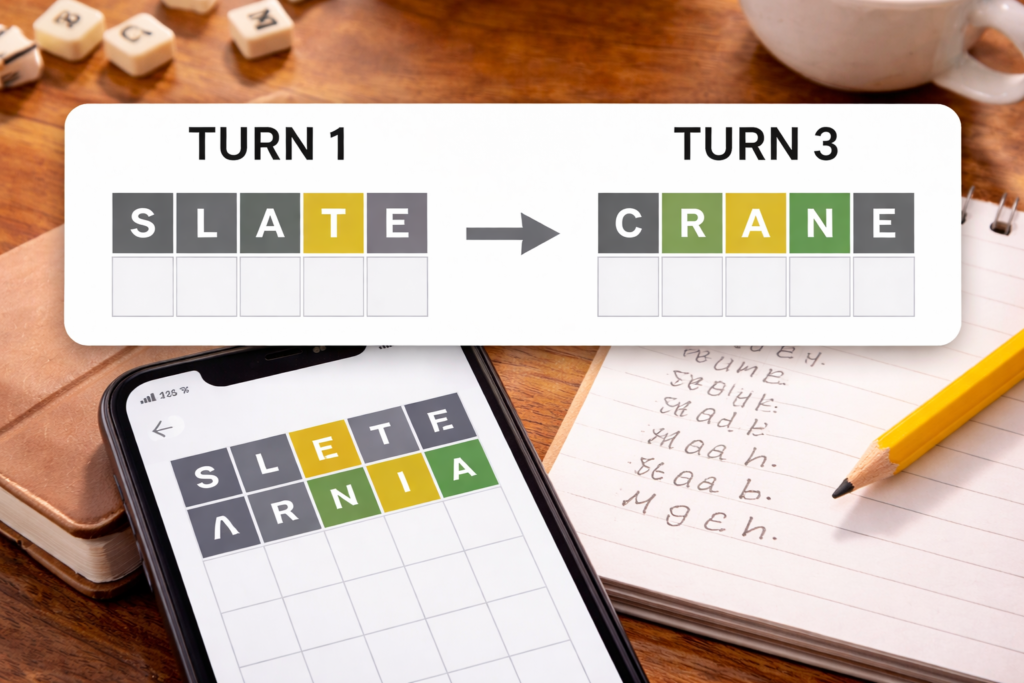
- SLATE
- CRANE
- TRACE
- AUDIO
These aren’t random. They include common vowels and consonants, increasing the odds of revealing useful information early.
Your first guess is about data, not glory.
Don’t Ignore Structure
Once you have confirmed letters, stop guessing randomly. Think in patterns. Mentally rearrange the letters you know belong in the word and consider common English constructions.
For example:
If you know there’s an “R” and an “A” but not their positions, test combinations that make linguistic sense instead of scrambling blindly.
Remember Duplicate Letters Exist
One common mistake? Forgetting the answer can include repeated letters. Words like “LEVEL” or “SHEEP” trip players up because we assume variety.
Hard Mode: The Advanced Layer
Many players don’t realize Wordle includes a Hard Mode setting.
In Hard Mode, you must use all revealed hints in subsequent guesses. If a letter turned green, it must stay in that position. If it turned yellow, you must reuse it somewhere.
This forces disciplined play and eliminates “testing words” that ignore prior clues. It’s significantly harder, and honestly, more satisfying.
If you’re serious about mastering quintessential Wordle, try Hard Mode for a week. It changes how you think.
WordleBot: The Modern Upgrade
To stay relevant in 2024 and beyond, we have to mention WordleBot.
The New York Times introduced WordleBot as an AI-powered analysis tool that evaluates your guesses after you finish a puzzle. It scores your skill, efficiency, and compares your choices to statistically optimal plays.
It’s like having a coach review your moves.
WordleBot adds a new layer of engagement — especially for competitive players who want data-driven improvement rather than just vibes.
Is Wordle Actually Good for Your Brain?
While it’s not a medical treatment or anything dramatic, Wordle does engage:
- Working memory
- Vocabulary recall
- Logical deduction
- Pattern recognition
Language-based puzzles are widely associated with cognitive stimulation. The key isn’t intensity — it’s consistency. And because Wordle is short, people stick with it.
That daily repetition matters more than playing for an hour once a month.
Common Wordle Mistakes
Even experienced players mess up. Some common errors include:
- Reusing gray letters accidentally
- Ignoring yellow letter placement rules
- Overcomplicating simple answers
- Not fully rearranging the letters they already confirmed
Sometimes the correct word is simpler than you expect. We look for obscure vocabulary when the answer is everyday English.
Pros and Cons of Wordle
Pros
- Free and accessible
- Quick daily challenge
- Encourages vocabulary growth
- Clean, distraction-free design
- Global shared experience
Cons
- Only one puzzle per day
- Some words feel unusually tricky
- Can become repetitive over time
Still, the balance heavily favors the pros. Otherwise it wouldn’t still dominate daily puzzle culture.
FAQs About Quintessential Wordle
Yes. The official New York Times version remains free to play daily, though some additional NYT Games features require a subscription.
Hard Mode forces you to use previously revealed hints in every guess. It increases difficulty and rewards precise deduction.
WordleBot is an AI analysis tool from The New York Times that evaluates your performance after completing a puzzle and suggests optimal strategies.
There’s no single perfect word, but statistically balanced openers with common vowels and consonants (like CRANE or SLATE) perform consistently well.
Final Thoughts: Why We Keep Coming Back
The quintessential Wordle experience isn’t about five letters.
It’s about ritual.
It’s about opening your browser each morning and facing one contained, solvable problem before the chaos of the day begins. it’s about sharing results without spoilers. it’s about trying to beat your average guess count.
In a digital world built on endless feeds, Wordle ends.
You solve it — or you don’t — and that’s it.
And maybe that’s the real reason we obsess over it.