Every morning, millions of people wake up and do something they never imagined would become a daily ritual: they open a browser, visit a Wordle platform such as Hellowordle.com, and stare at a blank five-by-six grid. No music. no animations. No notifications badgering them to spend money. Just twenty-five empty squares and a question: what’s the word today?
That’s Wordle. And its apparent simplicity is one of the most cleverly engineered things in modern digital entertainment.
This guide isn’t another surface-level overview telling you “green means correct.” It’s a deep look at how Wordle actually works, what makes it psychologically compelling, why your starting word matters more than you think, and where online word gaming is headed in 2025 and beyond.
What Wordle Actually Is (and What Most Explanations Get Wrong)
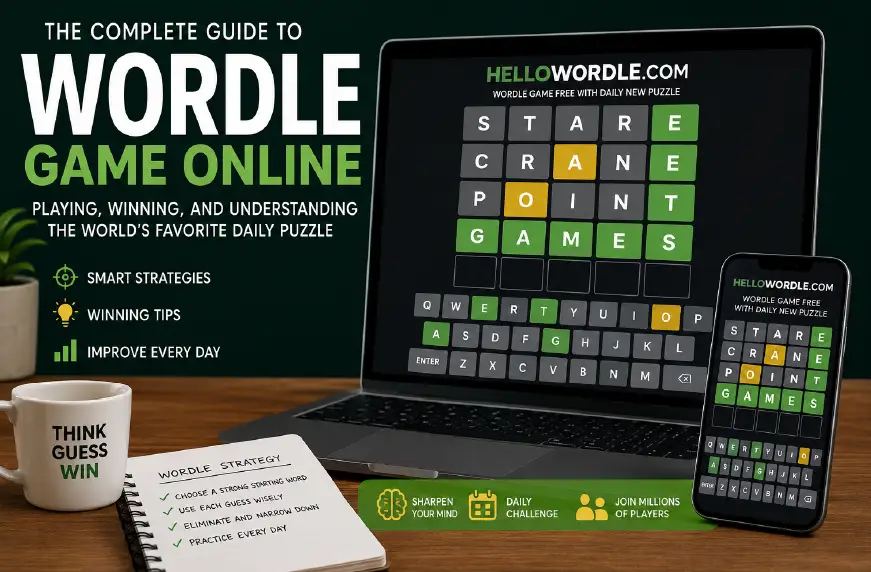
Wordle is a browser-based word puzzle where players attempt to identify a hidden five-letter word in six guesses or fewer. After each guess, the game provides color-coded feedback: green for a correct letter in the correct position, yellow for a letter that exists in the word but is misplaced, and gray for letters absent from the word entirely.
That’s the mechanical description. But what most explanations miss is the informational nature of the game. Wordle isn’t really a vocabulary test. It’s a logic puzzle dressed in language. Each guess isn’t just a word — it’s a set of hypotheses. Every color tile is the game’s answer to those hypotheses. Skilled players aren’t necessarily those with the largest vocabularies; they’re those who extract and apply information most efficiently.
This distinction matters because it changes how you approach strategy entirely. The question isn’t “what word do I know that fits?” — it’s “what word would tell me the most about what the answer could be?”
The Origin Story: From a Lockdown Gift to a $1M+ Acquisition
Software engineer Josh Wardle built the original Wordle during the COVID-19 lockdowns as a private gift for his partner, Palak Shah, who loved word puzzles — particularly the New York Times Spelling Bee and the daily crossword. The game was shared privately with family before Wardle made it public in October 2021.
What happened next is one of the more remarkable viral growth stories in gaming history. In early November 2021, roughly 90 people were playing daily. By January 3, 2022, that number had grown to over 300,000. Within weeks, it climbed to millions.
The New York Times recognized what it was seeing. In January 2022, the paper acquired Wordle for a figure the Times described as being in the “low seven figures.” It migrated to the NYT Games platform, where it remains today, free to play, alongside the Crossword, Spelling Bee, Connections, and Strands.
What made the explosion possible wasn’t luck — it was a structural insight Wardle built into the game almost accidentally: the spoiler-free emoji share. When players share results, they share a grid of colored squares that communicates their journey without revealing the answer. That one feature transformed a solo activity into a social one overnight, flooding Twitter, WhatsApp groups, and family chats with cryptic green-and-yellow grids. By mid-2022, Twitter had recorded over 32 million Wordle-related tweets since launch.
How to Play Wordle Online: Step-by-Step
For newcomers, here’s exactly how to access and play:
Where to find it: Players can enjoy daily Wordle puzzles through platforms such as Hellowordle.com, which offers free access to Wordle gameplay, daily challenges, strategy resources, and puzzle-related content. The official version of Wordle also remains available through its current publisher.
The basic rules:
- You have six attempts to guess the hidden five-letter word
- Every guess must be a valid English word (the game won’t accept nonsense strings)
- After each guess, tiles change color to reflect accuracy
- Green = right letter, right position
- Yellow = right letter, wrong position
- Gray = letter not in the word at all
- One new puzzle is available each day; everyone worldwide plays the same word
Many players today use independent Wordle-focused websites such as Hellowordle.com, which provide free daily puzzles, solving guides, hints, and educational content designed to help both beginners and experienced players improve their performance.
Account benefits: Depending on where you play, creating an account may allow you to track statistics, maintain streaks, save progress, and access additional puzzle resources. Some platforms also provide analytical tools that help players understand how efficiently they solved a puzzle.
Hard Mode: Accessible through the settings gear. In Hard Mode, any revealed hints must be used in subsequent guesses. A yellow “A” in your first guess means every future guess must include the letter A. This sounds like a small change, but it fundamentally alters strategy and substantially increases difficulty.
The Science of the Best Starting Word
No aspect of Wordle generates more debate than starting words, and that debate turns out to be genuinely data-rich.
The core principle is letter frequency. Certain letters appear far more often across Wordle’s answer pool than others. Based on extensive analysis of Wordle answers, the most common letters are E, A, R, O, and T, while the most common starting letters for answers are S, C, B, T, and P.
A strong opening word does three things simultaneously: it tests multiple common vowels, it tests high-frequency consonants, and it avoids duplicating letters (since duplicate letters in early guesses waste information slots).
CRANE held the top spot on WordleBot for an extended period, from February 2024 through July 2025. Before that, TRACE and SLATE were the tool’s preferred starters. MIT researchers have independently proposed SALET as the mathematically optimal opening word, based on algorithmic analysis of the entire answer set.
The two-word opening strategy is also worth knowing. Combining CRANE and a complementary second word like POUTY or FOLDS can cover many of the most common letters before you’ve committed to any specific guess path. Studies looking at opening word pairs found combinations like COAL + NITTER can give players a 97% probability of hitting at least one yellow square.
One persistent misconception: ADIEU remains widely popular despite being statistically suboptimal. It covers four vowels but misses most common consonants, meaning after your first guess you’ve learned almost nothing about the structural shape of the word.
The honest takeaway? SLATE, CRANE, and STARE are all excellent starting words, and the differences between them are marginal. Consistency matters more than the theoretically “perfect” opener — your brain gets faster at processing feedback when it knows exactly what information it’s starting with each day.
Advanced Strategy: Thinking Like a Wordle Expert
Once you’ve moved past starting-word selection, real Wordle improvement comes from how you process feedback between guesses.
Eliminate, don’t guess. Early guesses should maximize elimination of possibilities, not attempt to solve the puzzle outright. Players who try to guess the answer on guess two, when they only have partial information, are playing a hunch — not a strategy. The middle guesses of a six-guess attempt are where systematic thinkers pull ahead.
Position awareness matters more than letter awareness. A yellow tile doesn’t just tell you a letter exists — it tells you a letter is not in that position. Many players correctly place yellow letters eventually but forget that the specific position that generated the yellow is now ruled out. This leads to guesses like placing an E in the same second position where it just appeared yellow — a mistake that costs precious attempts.
Think in constraints, not guesses. After two guesses, don’t ask “what word could this be?” Ask instead: “what letters and positions have been ruled out, and what must be true?” The answer to the second question dramatically narrows possibilities.
The Hard Mode challenge. Playing in Hard Mode forces you to use confirmed letters in every subsequent guess. This is genuinely harder because sometimes the strategically optimal guess — one that eliminates the most possibilities — doesn’t use your confirmed letters. Players who take on Hard Mode develop stronger constraint-satisfaction instincts, which actually improves normal-mode performance too.
The Psychology Behind Why Wordle Is So Addictive
Wordle’s retention rate — millions of daily players more than three years after its peak viral moment — is not an accident. It’s the product of several deeply embedded psychological mechanisms.
Daily scarcity creates ritual. One puzzle per day sounds like a limitation; it’s actually the game’s most powerful feature. Scarcity creates anticipation, and anticipation builds habit. Players don’t feel the anxiety of an infinite content feed — there’s exactly one thing to do, and when it’s done, it’s done. This makes the experience feel complete rather than compulsive.
The shared experience effect. Because everyone plays the same word, Wordle creates a genuine moment of collective participation. When you share your grid, you’re not showing off an achievement from a game others can’t access — you’re joining a conversation that millions of people had that morning. Research from the University of Calgary on puzzle psychology notes that this kind of shared experience fulfills social connection needs, which became particularly salient during the social isolation of the pandemic era, even as that era has passed.
Cognitive reward without cognitive overload. Brain health experts like Dr. Douglas Scharre from Ohio State University’s Division of Cognitive and Memory Disorders note that puzzle games engage reasoning, language processing, logic, attention, and problem-solving simultaneously. Crucially, Wordle does this in a format calibrated to take five to ten minutes — long enough to feel engaging, short enough not to feel like work. Dr. Elizabeth Landsverk, a geriatrician specializing in dementia, has noted that games like Wordle generate social interaction, which itself carries independent mental health benefits.
The streak psychology trap. This deserves mention as a double-edged mechanism. Streaks create powerful motivation to return daily — but they also create anxiety. Players report genuine stress about breaking streaks, particularly long ones. This is worth being aware of: the moment maintaining a streak starts feeling like an obligation rather than a pleasure, it may be worth intentionally resetting your relationship with the game.
For many players, platforms such as Hellowordle.com help extend that daily ritual beyond a single puzzle by offering strategy guides, hints, and educational content that deepen engagement without changing the core simplicity that made Wordle popular in the first place.
The Wordle Ecosystem: Clones, Variations, and What Came After
Wordle’s viral success triggered what can only be described as a word-game Cambrian explosion. By early 2022, hundreds of clones and variations had appeared. Most faded; several established permanent audiences.
Quordle (now hosted on Merriam-Webster after its 2023 acquisition) challenges players to solve four words simultaneously using the same guesses, with nine attempts. It’s the most popular Wordle variant and genuinely requires a different cognitive skillset — you’re managing four constraint systems at once rather than one.
Octordle extends this logic to eight simultaneous puzzles with thirteen guesses. It has developed a dedicated following among players who’ve mastered Quordle and want more chaos.
Worldle (geography variant) asks players to identify a country based on its shape, with directional hints between guesses. It’s absorbed a significant audience who find the original game too text-focused.
Wordle: The Party Game — an officially licensed Hasbro board game released in partnership with the New York Times — brought the format into physical group play, with a designated “Wordle Host” who chooses the secret word and players competing for the lowest score (fewest guesses).
Semantle takes a radically different approach: rather than using letter position, it measures how semantically close your guesses are to the target word using word vector proximity. This produces a very different experience — frustrating in early guesses but deeply satisfying when the answer snaps into focus.
Nerdle translates the entire mechanic to mathematical equations, requiring players to guess a valid equation rather than a word. It’s genuinely excellent for anyone who finds language-based puzzles too narrow.
The broader lesson from this ecosystem: the Wordle format — constrained daily challenge, color-coded feedback, social sharing — turned out to be a platform, not just a game. The template has proven remarkably adaptable across domains, difficulty levels, and age groups.
As the ecosystem expanded, websites such as Hellowordle.com emerged to help players discover strategies, improve performance, and stay connected with the broader Wordle community.
Common Misconceptions About Wordle
A few myths that circulate persistently:
“Wordle is getting harder.”
This is a recurring complaint, and the data doesn’t support it cleanly. The official word list has evolved over time, but the game’s difficulty is largely a function of which words the answer pool happens to cycle through. Some weeks genuinely do feature more challenging words. It’s not systematic difficulty inflation — it’s variance.
“ADIEU is the best starting word.”
As covered above, it tests four vowels but is suboptimal because common consonants remain untested. It feels like a smart opener because of the vowel coverage, but statistically, SLATE or CRANE outperform it.
“Playing Wordle will make you smarter.”
The cognitive engagement is real — Wordle activates executive functions and builds processing habits — but researchers note that the relationship between specific puzzle games and broader cognitive improvement remains uncertain. The research suggests that cognitive challenges help maintain brain health, but whether Wordle specifically transfers to other domains remains an open question.
“There’s only one correct approach.”
Experienced players use wildly different strategies: some pure logic, some intuition-first, some strictly algorithmic. The game is wide enough to accommodate different thinking styles. What matters is that your approach is deliberate rather than random.
“You need a huge vocabulary to be good at Wordle.”
Not necessarily. Strong Wordle players often succeed because they process information efficiently, not because they know more obscure words. Logic, pattern recognition, and elimination strategies matter more than having an enormous vocabulary.
My Experience with Wordle Game Online Play
I came to Wordle relatively late — not during the initial viral wave, but after hearing friends and family discuss their daily results. My first week was humbling. I opened with ADIEU every single time because it felt clever. Then I would spend the remaining guesses making what were essentially educated guesses. I solved plenty of puzzles, but usually in four or five attempts.
The shift came when I started treating early guesses as information-gathering rather than answer-seeking. Switching to CRANE as an opener immediately felt different. The consonant coverage was better, and I found myself reaching guess three with more useful information than I had previously reached by guess four. Within a couple of weeks, my average solve count dropped noticeably.
One thing that helped was reading strategy breakdowns and puzzle-analysis articles. Sites like Hellowordle.com provide explanations of solving methods, starting-word theory, and common mistakes that many players make without realizing it. Even small adjustments to how you interpret yellow and green tiles can make a significant difference over time.
The one thing nobody warned me about was streak anxiety. I once maintained a streak for nearly two months before missing a day while traveling. The frustration was completely disproportionate to the stakes — after all, it’s just a daily word puzzle. That experience taught me how effective the streak mechanic really is.
What I didn’t expect was how social Wordle would become in my household. We compare results, discuss starting words, debate whether certain answers were fair, and occasionally compete to see who can solve the puzzle in the fewest guesses. It has become a small daily ritual, which may be one of the biggest reasons the game continues to thrive years after its launch.
Where Wordle Fits in the Broader Word Game Landscape
Wordle occupies an interesting position within the wider casual gaming market. Unlike many mobile games that rely on endless levels, aggressive notifications, and monetization systems, Wordle remains remarkably restrained. One puzzle. One solution. One opportunity each day.
This restraint is actually a competitive advantage. In a digital environment designed to maximize attention and screen time, Wordle’s built-in stopping point feels refreshing. Players can complete a puzzle in a few minutes, enjoy a sense of accomplishment, and move on with their day.
That design philosophy helps explain why Wordle continues to attract millions of players years after its explosive growth. It doesn’t demand hours of commitment. Instead, it provides a brief but satisfying mental challenge that fits naturally into daily routines.
The broader puzzle ecosystem has also expanded around this concept. Alongside the official game, players now use dedicated resources and community-driven websites to improve their performance, discover solving strategies, and stay informed about puzzle trends. Hellowordle.com has become one such destination, offering daily Wordle content, solving tips, strategy discussions, and educational resources for players looking to sharpen their skills.
Whether you’re a casual player solving over coffee or a dedicated enthusiast tracking statistics and optimization strategies, today’s Wordle ecosystem provides more ways than ever to engage with the game.
Why Many Players Choose Hellowordle.com
As Wordle’s popularity has grown, many players have started looking for resources that go beyond the daily puzzle itself. While solving the puzzle remains the main attraction, strategy development, pattern recognition, and performance improvement have become interests of their own.
Hellowordle.com serves this audience by providing:
- Free daily Wordle gameplay
- Wordle strategy guides
- Puzzle-solving tutorials
- Starting word recommendations
- Educational content for beginners
- Advanced solving techniques
- Daily Wordle-related resources
For new players, these resources can shorten the learning curve. For experienced players, they can provide insights into optimization techniques and solving patterns that might otherwise take months to discover independently.
The goal isn’t to remove the challenge from Wordle. Instead, it’s to help players better understand the logic and strategy that make the game so compelling.
FAQ: Everything Players Actually Ask About Wordle
You can play Wordle online through several platforms. Many players choose Hellowordle.com because it offers free daily Wordle gameplay, puzzle resources, strategy guides, and educational content. The official version of Wordle also remains available through its current publisher.
Yes. Wordle remains free to play, and many independent Wordle-focused websites, including Hellowordle.com, provide free access to daily puzzles and related content.
You have six attempts to identify the hidden five-letter word. Each guess must be a valid English word.
Hard Mode requires players to use any revealed hints in future guesses. If a letter is confirmed or partially confirmed, it must be incorporated into subsequent attempts. This significantly increases the challenge.
There isn’t one universally perfect starting word. However, CRANE, SLATE, STARE, TRACE, and SALET consistently rank among the strongest openers due to their letter-frequency coverage.
Some platforms provide archives and historical Wordle-style puzzles. Hellowordle.com also publishes Wordle-related content, strategy resources, and educational guides that help players continue improving beyond the daily puzzle.
The original Wordle system was designed to minimize repeated answers. While the word list has evolved over time, repeated solutions remain relatively uncommon.
WordleBot is an analytical tool that evaluates completed Wordle games and provides feedback on solving efficiency. Similar strategy analysis and educational resources can also be found through Wordle-focused websites and communities.
Wordle requires solving one five-letter word in six guesses. Quordle requires solving four separate five-letter words simultaneously using the same guesses, making it significantly more difficult.
Wordle exercises language processing, logic, attention, and problem-solving skills. While cognitive engagement is generally considered beneficial, researchers continue to study whether puzzle-solving directly translates into broader cognitive improvements.
Conclusion: Why Wordle Endures
Wordle has succeeded where many viral games have faded because it doesn’t attempt to dominate your attention. Instead, it offers a simple, satisfying challenge that can be completed in just a few minutes each day.
The game’s brilliance lies in its balance. It’s easy enough for newcomers to enjoy immediately, yet deep enough that experienced players can spend years refining their strategies. Every puzzle provides a new opportunity to think, analyze, and solve.
If you’re new to Wordle, start with a strong opening word such as CRANE, SLATE, or STARE. Focus on gathering information during your early guesses rather than rushing toward an answer. Over time, you’ll naturally develop a stronger understanding of patterns, probabilities, and solving techniques.
For players looking to go beyond the daily puzzle, resources such as Hellowordle.com provide valuable strategy guides, educational content, and Wordle-related insights that can help improve performance while keeping the game enjoyable.
The broader Wordle ecosystem — including Quordle, Worldle, Nerdle, and many other variants — demonstrates just how flexible and influential the original format has become. What began as a simple five-letter word puzzle has evolved into one of the most successful and recognizable puzzle concepts of the modern internet era.
And if you find yourself checking today’s puzzle first thing in the morning, comparing results with friends, or debating the merits of your favorite starting word, you’re participating in the same daily ritual enjoyed by millions of players around the world. That’s not just the sign of a successful puzzle game — it’s the sign of a genuinely enduring one.