
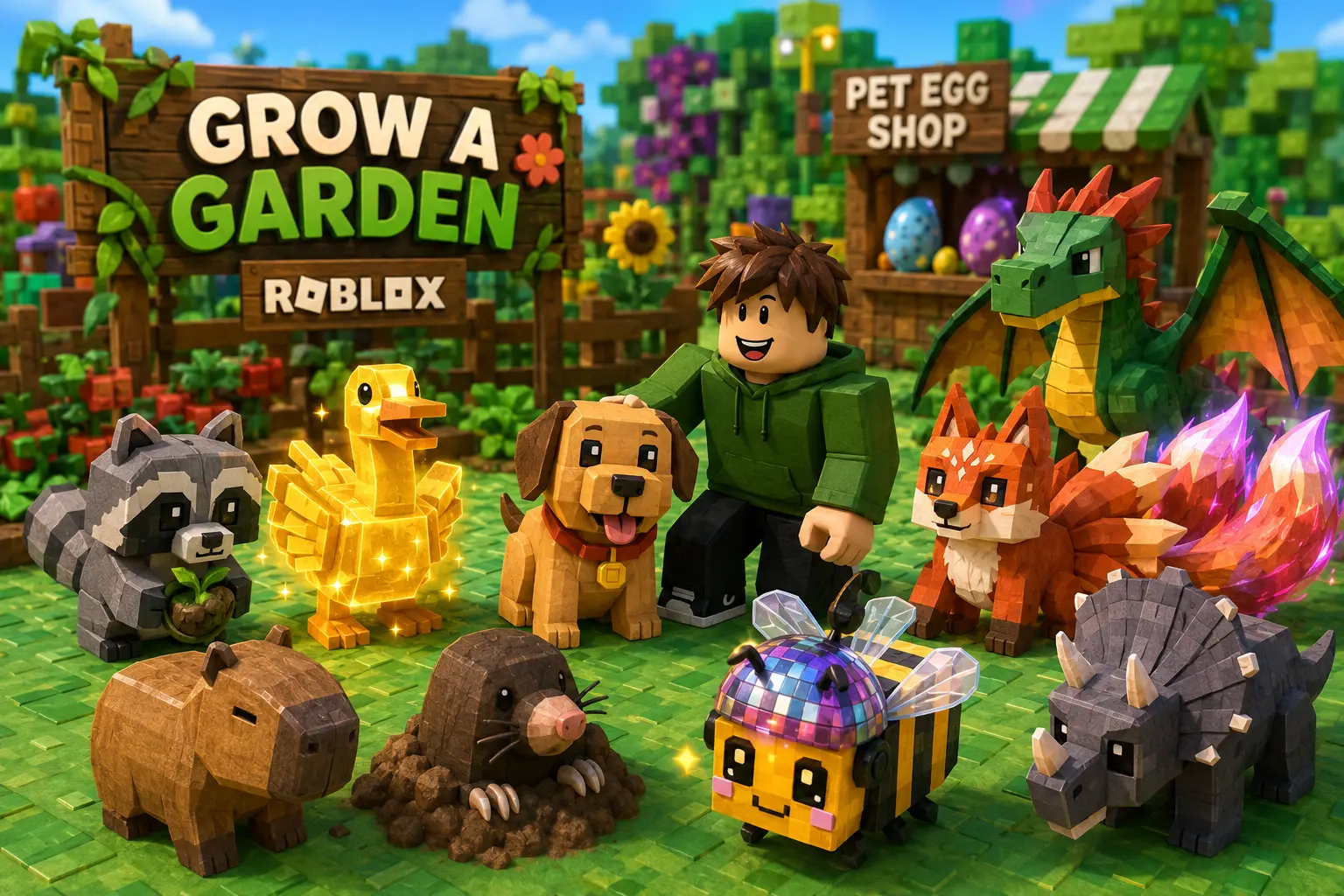
If you’ve spent any time in Grow a Garden over the last year, you already know the pets aren’t just cute background decoration. They’re the backbone of every serious farming strategy, and honestly, they’ve turned a simple gardening sim into something closer to a full-blown economy game. Whether you’re chasing a Golden Goose for its fortune-granting ability or just trying to keep your first Dog fed and happy, understanding how Grow a Garden pets actually work will save you weeks of wasted Sheckles and confused Discord messages.
This guide walks through everything: how pets function, which ones are worth your time, how the egg and hatching system works, common mistakes new players make, and a few things I’ve picked up from actually grinding this game for hours on end.
What Are Pets in Grow a Garden?
Pets were introduced to Grow a Garden through the Animal update, and they completely changed how players approach farming. Rather than just being cosmetic companions, each pet carries a passive ability that actively affects your garden — some boost mutation chances, some steal seeds from other players’ plots, some feed themselves so you don’t have to babysit them constantly.
Players start with three equip slots for active pets, though you can expand that number through gamepasses in the Limited Time Shop or by trading in aged pets. Pet inventory storage is separate from equip slots, and it can be expanded well beyond the base limit through Pet Pouches, Garden Ascension upgrades, and various shop purchases.
How Pet Rarity Works
Pets are sorted into rarity tiers, and this determines both their hatch odds and their general power level:
- Common
- Uncommon
- Rare
- Legendary
- Mythical
- Divine
- Prismatic
- Transcendent (the newest tier, introduced through the Bee Egg system)
Higher rarity generally means a stronger passive ability, but rarity alone doesn’t tell the whole story. A pet’s weight matters just as much. As a pet ages, its weight increases, which improves the strength and cooldown of its ability. A Godly-weight pet of a given species is meaningfully more valuable — and more useful — than a freshly hatched one of the same type, even though they share a name and rarity tier.
Mutations Add Another Layer
On top of rarity and weight, pets can carry mutations like Gold, Rainbow, or elemental variants, applied through the Mutation Machine, Golden Acorns, or Pet Mutation Shards. Only one mutation can be active on a pet at a time, and re-mutating typically requires aging the pet back up to a certain level. These mutated pets carry a noticeable trading premium, which is why serious players hold onto them rather than selling immediately.
Best Grow a Garden Pets Right Now
Community tier lists shift constantly as new eggs and events roll out, but a few names consistently sit near the top. According to recent community rankings, the strongest pets currently include the Golden Goose, Raccoon, Kitsune, Dragonfly, and Disco Bee, alongside newer additions like the T-Rex.
Here’s a quick breakdown of what makes the top tier so strong:
S-Tier Standouts
- Golden Goose – Can spawn a Fortune eggplant, and selling its fruit grants the Fortune mutation to other random plants in your garden.
- Kitsune and Raccoon – Both have the ability to steal seeds and harvests from other players, making them extremely popular for competitive or fast-paced servers.
- Disco Bee – Has a chance to turn any random fruit into a Disco mutation, which carries strong trade value.
- T-Rex – Can apply high-value mutations to random plants, making it a favorite for players focused on maximizing crop worth.
Solid Mid-Tier Picks
If you’re not chasing the absolute best pets yet, several mid-tier options are still genuinely useful for everyday farming:
- Capybara – Keeps your active pets from going hungry, which is a huge quality-of-life boost.
- Mole – Digs up free gears and Sheckles passively.
- Queen Bee – Grants pollinated mutations with a small chance of extra bonuses.
- Triceratops – Helps increase the size of newly hatched pets.
None of these will make you rich overnight, but they smooth out the grind considerably, especially in the early-to-mid game.
How to Hatch Pets in Grow a Garden
Pet eggs are purchased from the Pet Egg Shop using in-game currency, then placed in your garden to hatch. Each egg type has its own pool of possible pets with different hatch percentages — rarer pets naturally have lower odds, sometimes below 1%.
A few practical tips for hatching:
- Check hatch rates before buying an egg. Some eggs look appealing but have terrible odds for the pet you actually want.
- Buy in bulk when you can afford it. Hatching is a numbers game, and single-egg purchases rarely land you the rare pets.
- Watch for limited-time eggs. Seasonal events like the Bizzy Bee Event or the Summer Camp update introduce exclusive eggs that disappear once the event ends.
- Age your pets deliberately. Since weight boosts ability strength, it’s often worth holding onto a decent pet and letting it age rather than immediately swapping it for a “better” species at low weight.
Grow a Garden Pet Trading: What You Need to Know
Trading pets is arguably as big a part of the game as farming itself. Because the economy runs on constant supply and demand shifts, a pet’s real trade value can move significantly within just a few weeks, especially right after a content update.
A few trading principles worth keeping in mind:
- Weight changes everything. A Godly-weight pet trades for noticeably more than a fresh hatch of the same species.
- Cross-check values from more than one source. Prices for newly released pets, like recent Bee Egg additions, are often unstable for the first few weeks after launch.
- Demand doesn’t always match rarity. A high-rarity pet that isn’t currently popular can trade for less than a lower-rarity pet the community happens to be hyped about.
- Balance patches shift the meta. Since new content and Sheckle value adjustments roll out on a regular cadence, a trade that felt fair yesterday might not be fair after the next patch. The Grow a Garden Wiki on Fandom is a solid reference for checking current pet mechanics and history before you commit to a big trade.
Common Mistakes Players Make With Pets
- Selling pets too early. New players often hatch a decent pet and immediately trade it away for quick Sheckles, not realizing its value would have climbed significantly with age or an upcoming mutation event.
- Ignoring hunger mechanics. Pets that go hungry stop applying their passive bonuses, which quietly tanks your farming efficiency without an obvious warning.
- Overspending on eggs without checking odds. It’s easy to dump your entire currency stash into an egg with a flashy pet you’ll almost never actually hatch.
- Not diversifying pet slots. Running five of the same pet might sound efficient, but stacking different passives (seed theft, mutation boosts, hunger management) usually produces better overall results.
- Trading based on outdated value lists. Because the meta shifts with nearly every weekly update, relying on a screenshot from a month ago is a fast way to get a bad deal.
Best Practices for Managing Your Pet Collection
- Prioritize pet slots for abilities that directly support your current farming goal (mutation chance vs. currency generation vs. seed theft).
- Keep at least one hunger-management pet, like the Capybara, active at all times if you’re running longer sessions.
- Track upcoming events through the in-game update log or community hubs, since limited eggs vanish quickly.
- Don’t be afraid to hold a valuable pet rather than cashing it out immediately — patience during a hype cycle often pays off.
Personal Experience: Lessons From the Grind
I got into Grow a Garden the way most people probably did — a friend sent a clip of someone’s garden absolutely stacked with mutated fruit and I wanted to know how they got there. My first mistake was obvious in hindsight: I hatched a Rare-tier pet, thought it looked “good enough,” and sold it two days later for a fraction of what it would’ve been worth once it aged up. Lesson learned the hard way — patience with pet weight is genuinely one of the biggest value multipliers in this game, and rushing to cash out early cost me more than I realized at the time.
The second thing that surprised me was how much hunger management matters. I ran three offense-style pets (the seed-stealing types) for an entire session without realizing they’d stopped applying their bonuses because they were starving. My garden output basically flatlined and I couldn’t figure out why for almost twenty minutes. Once I swapped one slot for a Capybara, the difference was immediate and noticeable.
Trading was its own learning curve too. I got burned once trading a pet based on a value someone quoted from a Discord screenshot that turned out to be nearly a month old — right after that, a balance patch had quietly reshuffled prices. Now I always cross-reference at least two sources before agreeing to a bigger trade, and I treat any number that’s more than a week old as a rough estimate rather than gospel.
If there’s one takeaway from all my hours in this game, it’s that pets reward patience far more than impulse decisions. The players with the strongest gardens aren’t necessarily the ones who got lucky on a rare hatch — they’re the ones who aged their pets properly, diversified their abilities, and paid attention to the shifting economy instead of reacting to every hype wave.
Frequently Asked Questions
What is the rarest pet in Grow a Garden?
Rarity currently tops out at Transcendent, a tier introduced through the newer Bee Egg system that sits above the previous top tier, Prismatic. Within Prismatic and below, pets like the Kitsune and Headless Horseman are also considered especially rare due to how they interact with the game’s mutation system.
How do you increase a pet’s level or age in Grow a Garden?
Pets gain weight and effective “age” through active use in your garden over time. Certain pets, like the Ostrich, and specific event mechanics, such as the Pet Age Break Machine, can also accelerate this process. The level cap has been raised multiple times as the game has updated, most recently up to 500 following the Summer Camp content additions.
What’s the best pet for a beginner in Grow a Garden?
For new players, a hunger-management pet like the Capybara or a general mutation-boosting pet is usually more practical than chasing S-tier rarities early on. It’s better to stabilize your farming loop first before investing heavily in eggs with low hatch odds.
Can you trade pets in Grow a Garden?
Yes, pet trading is a core part of the game’s economy. Values shift based on rarity, weight, mutations, and current community demand, so it’s worth checking multiple recent sources before finalizing any trade, especially for pets added in the last few weeks.
Do pet mutations disappear if you re-mutate a pet?
Yes, only one mutation can be active on a pet at a time. Applying a new mutation typically requires the pet to be aged back up, so it’s worth thinking carefully before overwriting a mutation you might want to keep.
Conclusion
Pets have become the real engine behind Grow a Garden’s farming and trading loop, and understanding rarity, weight, and mutation mechanics will get you further than any lucky egg pull ever could. Start by stabilizing your garden with a practical, hunger-managing pet, learn to be patient with aging rather than flipping pets too early, and always double-check trade values before locking in a deal — the meta shifts fast, sometimes within a single weekly update.
If you’re serious about building a strong collection, keep an eye on official update logs and community trading hubs so you’re never working off stale information. The players who consistently come out ahead are the ones paying attention, not the ones chasing every shiny new egg.
For Play Wordl Game Visit: Hellowordle
Disclaimer: This article is intended for informational and entertainment purposes only and reflects publicly available community knowledge about Grow a Garden as of mid-2026. Grow a Garden is a Roblox experience developed by its respective creators, and all in-game values, rarities, and mechanics are subject to change with future updates. Always verify current pet values and mechanics through official game sources or active community hubs before making trading decisions.