By a language enthusiast with a decade of competitive word gaming and ESL teaching experience
Introduction: Why Uncommon 5 Letter Words Deserve More Attention
Most people cruise through life with a vocabulary of roughly 20,000 to 35,000 words — comfortable, functional, and entirely forgettable. But tucked inside the English language is a wildly underused collection of uncommon 5 letter words that are precise, colorful, and surprisingly practical. Whether you’re a Wordle addict hunting for that perfect opening guess, a writer chasing the exact word for a mood that “sad” simply doesn’t capture, or a student prepping for the GRE, these words are worth your time.
Five-letter words sit in a linguistic sweet spot. They’re long enough to carry real semantic weight, short enough to slip into everyday conversation without sounding pretentious, and plentiful enough that the English language offers thousands most people have never encountered. According to Merriam-Webster, the dictionary contains over 470,000 entries — and a surprising chunk of those are five-letter gems collecting dust.
This article walks you through a curated set of uncommon 5 letter words, where they come from, how to use them, and why expanding into this territory makes you a sharper thinker and communicator.
What Makes a 5 Letter Word “Uncommon”?
Before diving in, it helps to define the term. An uncommon 5 letter word isn’t necessarily archaic or obsolete. It’s a word that:
- Appears rarely in everyday speech or casual writing
- Is absent from most people’s active vocabulary (though they might recognize it when they see it)
- Carries a specific meaning that common synonyms only approximate
Think of words like lurid, vapid, or inane — technically known to many, but rarely deployed. Now go deeper. Words like cwtch, vrouw, sward, or agape (used as an adjective, not the theological concept) — these are the ones that make language feel alive again.
A Curated List of Uncommon 5 Letter Words (With Meanings and Examples)
Words That Describe People and Emotions
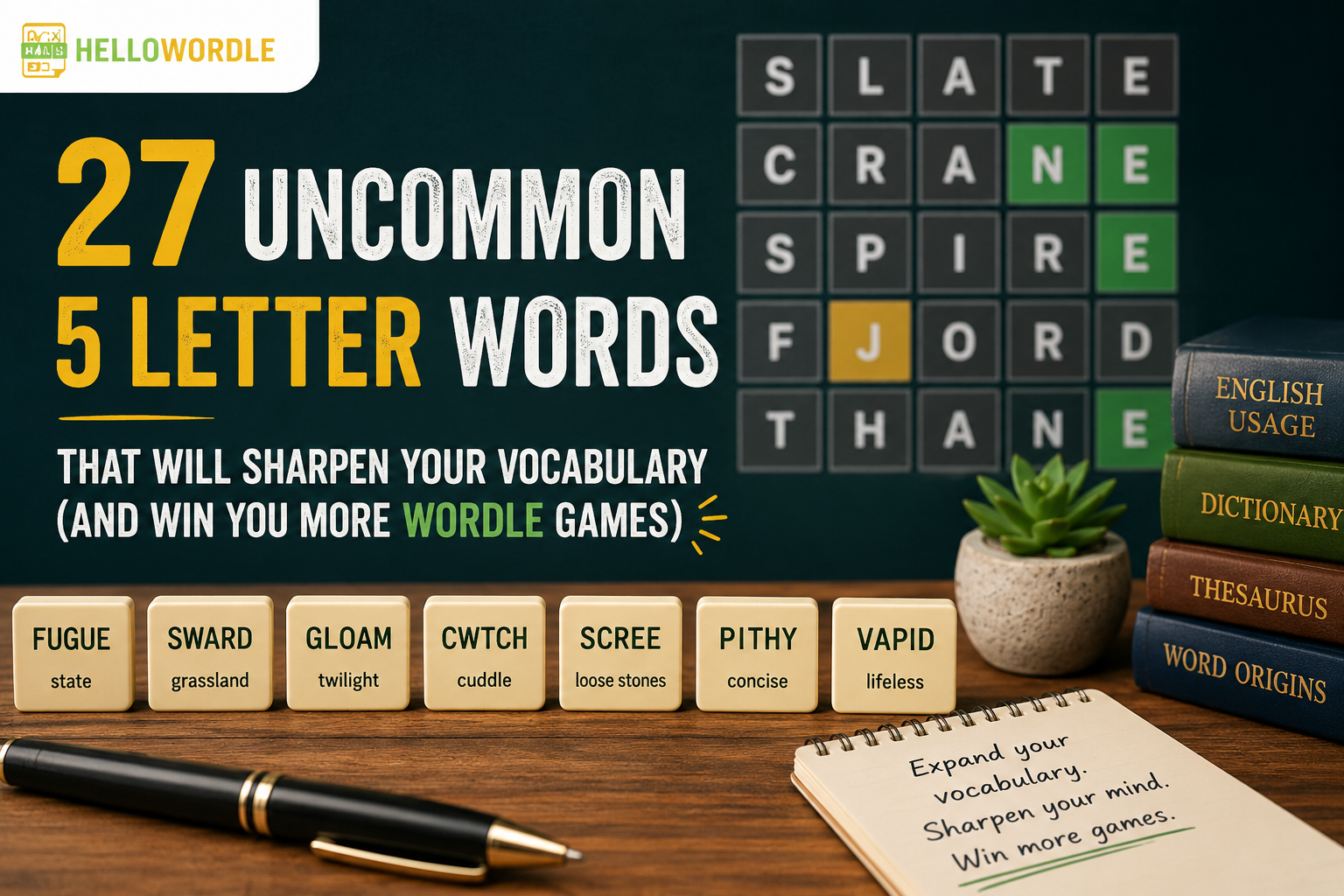
FUGUE — A state of dissociation or, in music, a contrapuntal compositional technique. “She moved through the week in a fugue, answering emails but barely present.”
WROTH — Intensely angry; archaic in feel but deeply satisfying to use. “He was wroth when he discovered the contract had been altered.”
MOPES — Plural noun or verb; a state of low-grade, listless sadness. “The mopes set in every January, no matter how many resolutions I made.”
SULKY — Moody and withdrawn, but with an edge of resentment. “The sulky silence between them lasted three days.”
VAPID — Offering nothing stimulating or challenging; flat. “The vapid small talk at the networking event left her exhausted.”
Uncommon 5 Letter Words from Nature and the Physical World
SWARD — A stretch of short grass; a lawn or grassy expanse. “They laid a blanket across the sward and watched the clouds pass.”
SCREE — A mass of small loose stones on a mountain slope. (Beloved by hikers and crossword enthusiasts alike.) “The descent was treacherous — all loose scree and unstable footing.”
SPUME — Froth or foam, especially on the sea. “The wave broke and left a line of spume along the sand.”
GLOAM — Poetic for twilight or dusk; rarely used in prose, which makes it striking. “They walked home through the gloam, not needing to speak.”
BRACT — A leaf-like plant structure below a flower; common in botany, rare in conversation.
Unusual but Usable Words for Writers
ELIDE — To omit or slur over a sound or syllable; also used abstractly to mean “to leave out.” “The author chose to elide the most painful parts of the story, which made them more powerful.”
ABIDE — Often used passively (“can’t abide”), meaning to tolerate or endure with patience. “She couldn’t abide the noise from the construction for another week.”
TROPE — A figurative or metaphorical use of a word; also a recurring theme or device. Widely used in literary criticism and increasingly in everyday internet commentary.
LIMPID — Clear and calm; used for water, eyes, prose, or music. Five letters of crystalline precision. (Note: limpid is 6 letters — its five-letter cousin is lenis, meaning a consonant produced with little muscular tension.)
PITHY — Concise and forcefully expressive. A word that describes itself perfectly. “His pithy remarks made the meeting worth attending.”
Obscure 5 Letter Words Worth Memorizing for Word Games
If you play Wordle, Scrabble, or any competitive word game, these uncommon 5 letter words are worth keeping in your back pocket. Wordle’s word list, maintained by The New York Times, draws from a curated set of five-letter words — and knowing the uncommon ones gives you a genuine edge.
CWTCH — A Welsh word meaning a small storage space or a loving cuddle. Valid in some dictionaries, beloved in others.
ADZES — Plural of adze, a wood-cutting tool with a blade at right angles to the handle. The Z makes it golden for Scrabble.
FJORD — Yes, only five letters. The J and the F make it a high-value Scrabble play.
THANE — A rank in Anglo-Saxon England, equivalent to a minor nobleman. Macbeth’s title before he became King.
OXBOW — A U-shaped curve in a river; also a type of wooden collar for oxen.
The Linguistic Origins Behind These Words
Many uncommon 5 letter words feel strange because they come from outside the dominant Latin-French-Germanic trifecta that shapes most English vocabulary. Scree is from Old Norse. Cwtch is Welsh. Spume comes directly from Latin spuma. Sward is Old English, related to the word for skin.
Understanding etymology does more than satisfy curiosity — it helps words stick. When you know that gloam shares ancestry with the Old English glōm (meaning twilight), you feel the word rather than just memorizing it. Organizations like the Oxford English Dictionary trace these lineages in extraordinary detail and remain the gold standard for etymological research.
Benefits of Expanding Your Vocabulary With Uncommon 5 Letter Words
- Precision in writing. Every strong writer knows the difference between the right word and the almost-right word. Uncommon words often exist precisely because common ones weren’t specific enough.
- Cognitive engagement. Learning new vocabulary builds neural pathways. Studies in cognitive linguistics consistently link vocabulary breadth with stronger reading comprehension and critical thinking.
- Word game performance. Knowing uncommon 5 letter words is a direct competitive advantage in Wordle, Scrabble, and similar games.
- Memorable communication. Using a word like wroth instead of angry or spume instead of sea foam creates a small but genuine moment of texture in otherwise flat communication.
- Reading comprehension. Classic literature, legal documents, academic writing, and quality journalism all use uncommon words regularly. Knowing them removes friction.
Common Mistakes When Using Uncommon Vocabulary
Forcing it. The biggest error is inserting a rare word where a common one works fine — purely for effect. It reads as performative and usually backfires.
Misusing meaning. Words like elide or trope are frequently misused because people know them vaguely but not precisely. Always verify meaning before using.
Mispronouncing in speech. Epitome and awry have tripped up thousands of people who knew the words from reading but never heard them spoken. Same risk applies here — hear the word before you say it.
Over-correcting. Some people learn uncommon words and immediately abandon common ones. That’s overcorrection. Great vocabulary means having both.
Personal Experience: How Uncommon 5 Letter Words Changed the Way I Read and Write
I came to uncommon 5 letter words through Wordle, honestly. Like millions of others, I started playing during the pandemic — once a day, nothing serious. But I kept losing to words like CAULK, KNOLL, and TROVE, and it bothered me. I started a running list.
What I didn’t expect was how that list became a genuine vocabulary study. I’d look up each word, find its etymology, read a sentence that used it well. Then I’d try to use it once within the week — in an email, in my journal, in conversation. The word pithy became a personal favorite because I found myself actually needing it in feedback to students. Vapid replaced a half-dozen vague phrases I’d been recycling for years.
The shift in my writing was gradual but real. My sentences got tighter. I stopped reaching for approximate words and started pausing long enough to find the right one. That pause — three seconds, sometimes ten — is where the good vocabulary lives.
I also started noticing these words in books I’d read before. Rereading certain novels after building my vocabulary felt like watching a familiar film with the sound properly mixed for the first time. The words had been there all along; I just hadn’t had the ears for them.
The practical lesson: don’t try to learn ten uncommon words a day. Learn two a week, use each one at least three times in context, and let them settle. That’s the method that actually sticks.
Tips and Best Practices for Learning Uncommon 5 Letter Words
- Read widely and slowly. Literary fiction, longform journalism, and essays are where these words live. The New Yorker is a reliable source.
- Use spaced repetition apps like Anki to reinforce new vocabulary over time.
- Keep a word journal. Handwriting new words improves retention compared to typing them.
- Play word games daily. Wordle, Scrabble, and Quordle expose you to uncommon 5 letter words in context.
- Read etymologies. Understanding word roots makes unfamiliar words feel familiar faster.
FAQs: Uncommon 5 Letter Words
Good options include SCREE, SPUME, SWARD, FJORD, THANE, ADZES, and GLOAM. These contain common letter combinations but are rarely guessed because most players don’t have them in their active vocabulary.
Research and data analysis from the Wordle community consistently point to words like CRANE, SLATE, RAISE, and AUDIO as high-value openers due to their coverage of common vowels and consonants. Uncommon words are typically better as second or third guesses.
Validity depends on the official Scrabble dictionary in use. The Official Scrabble Players Dictionary (OSPD) and the Official Tournament and Club Word List (OWL/TWL) are the standard references in North America. Always verify before playing.
Use each new word in context three times within 48 hours of learning it. Combine that with spaced repetition software. Linking words to their etymology also significantly improves retention.
Five letters offer a balance between difficulty and solvability. There are enough five-letter words to create variety without making games impossibly obscure. Wordle popularized the format, but five-letter word puzzles have appeared in print since at least the mid-20th century.
Archaic words are no longer in current use and would read as outdated or confusing in modern contexts. Uncommon words are still valid and in use — just rarely. WROTH is uncommon; FORSOOTH is archaic.
Yes, and this is well-documented in cognitive science. Vocabulary breadth correlates with reading comprehension, analytical reasoning, and the ability to make nuanced distinctions. The Sapir-Whorf hypothesis suggests that the words we have available shape the thoughts we can think precisely — a controversial but persistent idea worth considering.
Conclusion: Words Are Tools — Keep the Rare Ones Sharp
Uncommon 5 letter words aren’t trophies. They’re not things you collect to display. They’re tools — precise, durable, and often irreplaceable. The word gloam does something that “twilight” approximates but doesn’t quite match. The word pithy lands differently than “concise.” These distinctions matter in good writing, in careful thinking, and yes, in winning your daily Wordle.
Actionable Takeaways
- Pick two uncommon 5 letter words from this article and use each in writing this week.
- Download a spaced repetition app (Anki is free) and start a vocabulary deck.
- When you encounter an unfamiliar word in reading, look it up immediately rather than inferring from context alone.
- Play Wordle or a similar game daily — it exposes you to uncommon words in a low-stakes, high-engagement format.
- Read the etymology of every word you deliberately learn. It takes 30 seconds and doubles retention.
Language rewards the curious. The uncommon words are already out there, waiting. All you have to do is show up for them.
Ready for a word challenge? Visit HelloWordle and test your vocabulary with engaging Wordle-style puzzles.